
- Home
- About Us
- Sailing Courses
- Powerboat Courses
- SLC - Sailing License
- Sailing Vacations
- Sailing Instructors
- Practical Courses
- Fighting Childhood Cancer
- Free Courses Signup
- Gift a Sailing Course
- Sailing Opportunities
- Sailing Licenses and Certifications
- About the Sailing Certifications
- Sailing Blog & Helpful Articles
- NauticEd Podcast Series
- Yacht Charter Resources
- School Signup
- Instructor Signup
- Affiliate Signup
- Boat Sharing Software
- Sailing Industry Services
- Support & Contact
- Newsroom
- Privacy Policy

Skipper Large Sailboat | Online Sailing Course

Learn to Sail Large Sailboats (Keelboats)
This online course offers a comprehensive curriculum designed for beginner to intermediate sailors seeking to sail large sailboats (keelboats) 26 ft (8m) and above. Covering theory, knowledge, and strategies for sailing in nearshore and moderate conditions, this course includes topics such as sail trim, navigation basics, electronics, and handling emergencies. Optional practical training is also available through an international instructor network. By course completion, students will possess the knowledge to effectively sail larger sailboats in various sailing conditions.
Estimated Time: 20 hours
Price: $75 $67.50 (or $62 with the Skipper Rank bundle of sailing courses)
The Skipper Large sailboat online sailing course is designed to teach you all the theory, knowledge, and strategies necessary to safely and competently sail large sailboats (keelboats) that are 26ft or larger, nearshore, and in moderate conditions. Optional practical training is available through our international instructor network. Whether you are a beginner or intermediate sailor, you simply must learn the theory and knowledge to sail large keelboats; including sail trim, navigation basics, electronics, and handling emergencies.
By the end of this course, you will have a comprehensive understanding of how to sail larger boats, and you will have gained the knowledge necessary to confidently handle any situation that may arise while sailing in nearshore and moderate conditions.
Topics covered in the Skipper Large Sailboat Course
- Weather and Sea Conditions
- Electrical Systems
- Auxiliary Power
- Rigging: Standing and Running
- Rules of the Road
- Slip Departure and Return
- Sailing
- Communications & Navigation
- Anchoring and Mooring
- Coping with Emergencies
We guarantee both your satisfaction AND Lifetime access to any sailing course you buy from us
More about the Skipper online sailing course
- Learn to sail large sailboats with this comprehensive online sailing course
- Available immediately online
- Extensive and essential knowledge for sailing at the beginner / intermediate levels for keelboats 25 ft (7.5m) and above
- This Sailing Course takes approximately 20 hours of total time to complete
- Take as long as you need to complete
- Return as many times as you like to review
- You may take the tests anytime and as many times as you like online via browser or offline via our iPad/iPhone testing app. See our sailing apps page
- Adds the Skipper Course to your Sailing Certificate and Resume
- Optional Practical Training available through our international network of instructors
- This course follows the American National Standards EDU-3 for sailing training and is properly modified to account for large sailboats 25 ft to 56 ft (7.3m to 17m)
- View Skipper Course excerpts
This is an ONLINE course and test viewable in your browser window. The course pages are mobile-friendly. Thus you can review on any of your devices - computer, tablet, or phone.
Today's Investment: $75 $67.50 (or $62 with the Skipper Rank bundle of sailing courses)
Buy this Skipper course as a hardcopy paper book from our Amazon Store. Videos, animations, and links are included in the book using QR codes.
Not convinced yet that online sailing courses are cool? Visit our fully interactive and completely free Basic Sail Trim Sailing Course. You'll see why online e-learning is SO MUCH BETTER than a boring old Book.
Upon completion, you will feel confident that you know the theory of what to do when in command of a sailboat. And if you're new to the fun of sailing, you'll look like a pro in front of your hands-on, on-the-water instructor.
Are you ready to "get your feet wet" and feel the exhilaration of sailing? Then let's get started!
The test is reasonably simple as long as you have read the material. You can take the test as many times as you like to pass or improve your score without any extra cost. Once passed, along with the Maneuvering (and docking) Under Power course, you are awarded the NauticEd Skipper Certificate and Rank and you'll be on your way to building your sailing competency resume, which can be used with charter companies worldwide. And the great thing, once you've registered, you can log back in for life for FREE to review the material and brush up your skills. We're constantly updating the course and adding information on new technologies as they emerge, so for just $67.50 - you'll always be up to date.
If you still have questions about NauticEd, the courses, and/or the sailing certifications, just ask our automated intelligent support system a question or contact us via email or phone we're happy to help. Otherwise, register for the Skipper Course now and enjoy your new adventures to come!
Learn all the theory of sailing in the comfort of your home at your own pace with NauticEd. Register for the Skipper Course now!
By Grant Headifen
NauticEd Global Director of Education
View Skipper Large Keelboat Course excerpt
Student Reviews
Samuel H.
2024, 22 Nov. 16:15
The detail in information.
John G.
2024, 25 Sep. 23:25
The course was very detailed. I really felt I learned it lot. (I have taken several ASA courses, including Coastal Navigation, but this was much more demanding..which is good!
Jim F.
2024, 25 Sep. 19:59
Very thorough and clear explanation of topics. Good influx of videos as well.
Thomas B.
2024, 03 Sep. 11:57
Well laid out.
Roger T.
2024, 28 Aug. 22:01
Great, comprehensive review of key areas.
Allen F.
2024, 23 Aug. 04:05
So much to delve into with all the VR and links to videos. I am so impressed by the work you put in to developing this course !
Charles H.
2024, 23 Aug. 01:38
This was really long and comprehensive but exceptional every bit of the way. It provided a solid overview of not just knowledge but responsibilities and for that I am grateful.
Craig B.
2024, 01 Aug. 01:36
I have more confidence. Some repeating of other courses, which was actually nice.
Volodymyr Z.
2024, 18 May. 14:53
Some parts are interesting and having a sense of humor
Peter S.
2024, 13 Mar. 21:30
Very complete
John E.
2024, 12 Mar. 03:35
After years and years, such a great refresher!
Shane F.
2024, 07 Mar. 13:01
Easy to follow along with and apply theoretical knowledge leant in a practical session later
List Price: $75.00 Price: $67.50 You Save: $7.50 (10%)
Excerpt from the course
Expand Excerpt from the courseModule 4 Rigging and Sails- Excerpt:
The following illustration shows the parts of the sail and associated control lines. Of note is the bolt rope which is one of the few actual ropes on a boat (another is the bell rope).
- The bolt rope provides strength to the luff of the sail and is used also to slide into the track if there is one. On a head sail the bolt rope provides strength to the luff of the sail when "hanks" are used.
- Hanks are basically sliding clamps that slide up the forestay and are clamped onto the bolt rope at the leading edge (luff).
- The main halyard is attached to the head of the sail and is used to pull the sail up the mast.
- The gooseneck is a swivel connection from the boom to the mast.
- The reefing points are points where the sail can be pulled down in order to reef the sail if a roller furling system is not used.
- The topping lift holds the back of the boom up.
- The boom vang holds the boom down when beating to the wind. On downwind legs, the boom vang can be loosened to provide more shape to the sail.
- The cunningham pulls the sail down tight and is used also when reefing.
- The outhaul line is attached to the clew to pull the sail out along the boom.
Click on a letter to show the name - click again to hide. Then test yourself.
Module 5 Rules and Safety- Excerpt:
In the video below, you can see two sailboats on a collision course. The sailboat on a port tack correctly changes course to avoid the sailboat on a starboard tack. The port tack boat also could have turned to starboard to duck in behind the other boat. However, in this case, it chose to tack. The decision to tack or duck is up to you.
Module 6 Slip Departures and Returns - Excerpt:
(3) Wind pushing into the dock and current from behind.
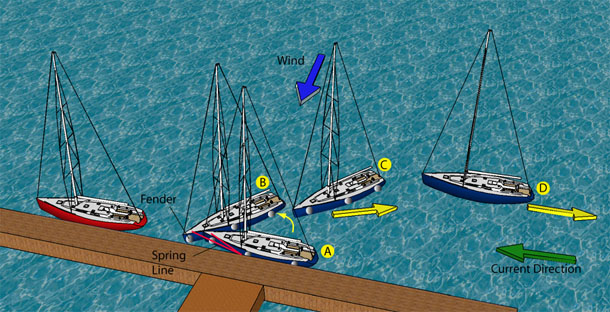
This is a little more tricky. If you try to go out forward the wind could potentially push you into other boats. Additionally, as you turn the wheel to head out, the rear of the boat will swing around towards the dock and other boats. therefore it is recommended that you reverse out using a spring line.
(A) Once you are confident in your plan,
- Appoint a crew member to use a fender at the front of the boat to prevent the boat from touching the dock.
- Release and stow the dock lines but leave one spring line from the dock near the center of the boat attached to the front of the boat.
- The spring line should be arranged so that it is attached to the forward cleat, runs freely around the dock cleat, and returns back to the appointed crew member. In this manner, the crew member can release the line and retrieve it by letting it slip around the dock cleat. ENSURE that there are no knots in the line to get caught on the dock cleat as it runs through.
- Turn the wheel towards the dock and engage the forward gear.
- This will have the effect of pushing the rear of the boat away from the dock.
(B) Once the boat has turned out from the dock, engage reverse and have your forward crew member release and retrieve the spring line.
(C) Continue backing out to be completely clear before engaging forward gear. Remember the rear of the boat will swing back towards the dock once you engage forward and turn the wheel to windward, so ensure there is plenty of room.
Module 7 Sailing - Excerpt:
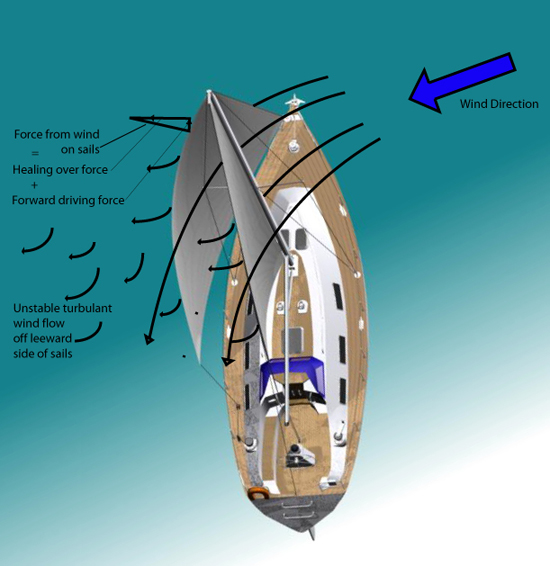
Conversely, when you ask the wind to bend too much, the wind will spawn off creating turbulent airflow. This reduces the effect of the sails and slows the boat. The higher the velocity of the wind the less the wind tends to bend. This is one of the reasons why in high wind conditions you need to reduce the size of the sail. Since the sail is smaller when reefed, the wind is required to bend less over the distance from the front (luff) of the sail to the back (leech) of the sail and therefore the wind will not break away from the sail as much. Once the wind breaks away from the low-pressure side, as shown in the diagram below, you're reducing efficiency. In the same way, an airplane will stall. When the flow of air breaks away from the top side of the wing, the lift is lost and the plane quickly aims itself at the ground. In sailing, the result is less dramatic. Simply let the sail out and the wind will reattach to the leeward side of the sail.
Module 9 Anchoring and Mooring- Excerpt:
Care must be given to swing. As the wind changes during the night, your boat will move with the wind and can put you into a precarious situation by being too close to the shore. Many times you'll find an anchorage area with moorings. Remember that boats tied to moorings swing less than anchored boats. In this circumstance, you may swing into other boats. The golden rule is "watch your swing".
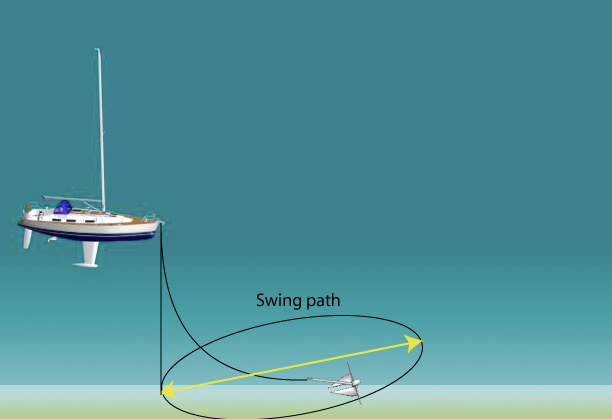
In addition, consideration must be given to the tide. As the tide "ebbs" out, you not only get closer to the bottom but your swing circle grows and the shore becomes closer. This diagram shows your swing path with deep water and the correct scope.
Module 10 Emergencies - Excerpt
Deep Beam Reach
- Bear away to a broad reach
- Trim the main sail for speed, furl, or drop jib.
- Tack
- Sail a beam reach toward the victim.
- Make the final approach to the leeward of the victim.
THE TESTS
Each Module has associated with it approximately 20 test questions. Here is an example?
Q Who has the Ultimate right of way in this scenario?
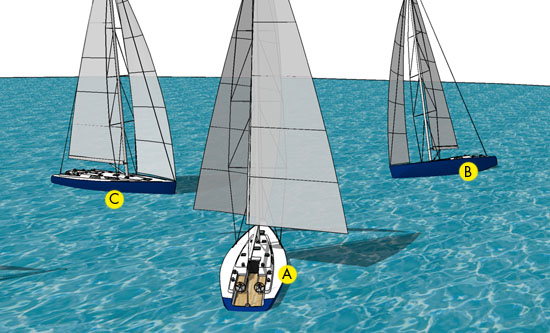
You will find the answer to this question in Module 5 of the Skipper Course.
Upon passing all the tests associated with each module, your NauticEd Sailing Certificate is automatically updated. This is not a USCG Captain's license. It is an acknowledgement that you have passed the NauticEd Skipper Course which is recognized by charter companies worldwide.
Other Courses you may consider are:
Free Basic Sail Trim Sailing Course
Qualified Crew Sailing Course
Get your sailing certification started now with the NauticEd Skipper Sailing Course.
Sea talk testimonials
I am impressed with my students and the way they came so prepared for a week-long charter, not knowing a thing about sailing prior to that. Kudo to this program.